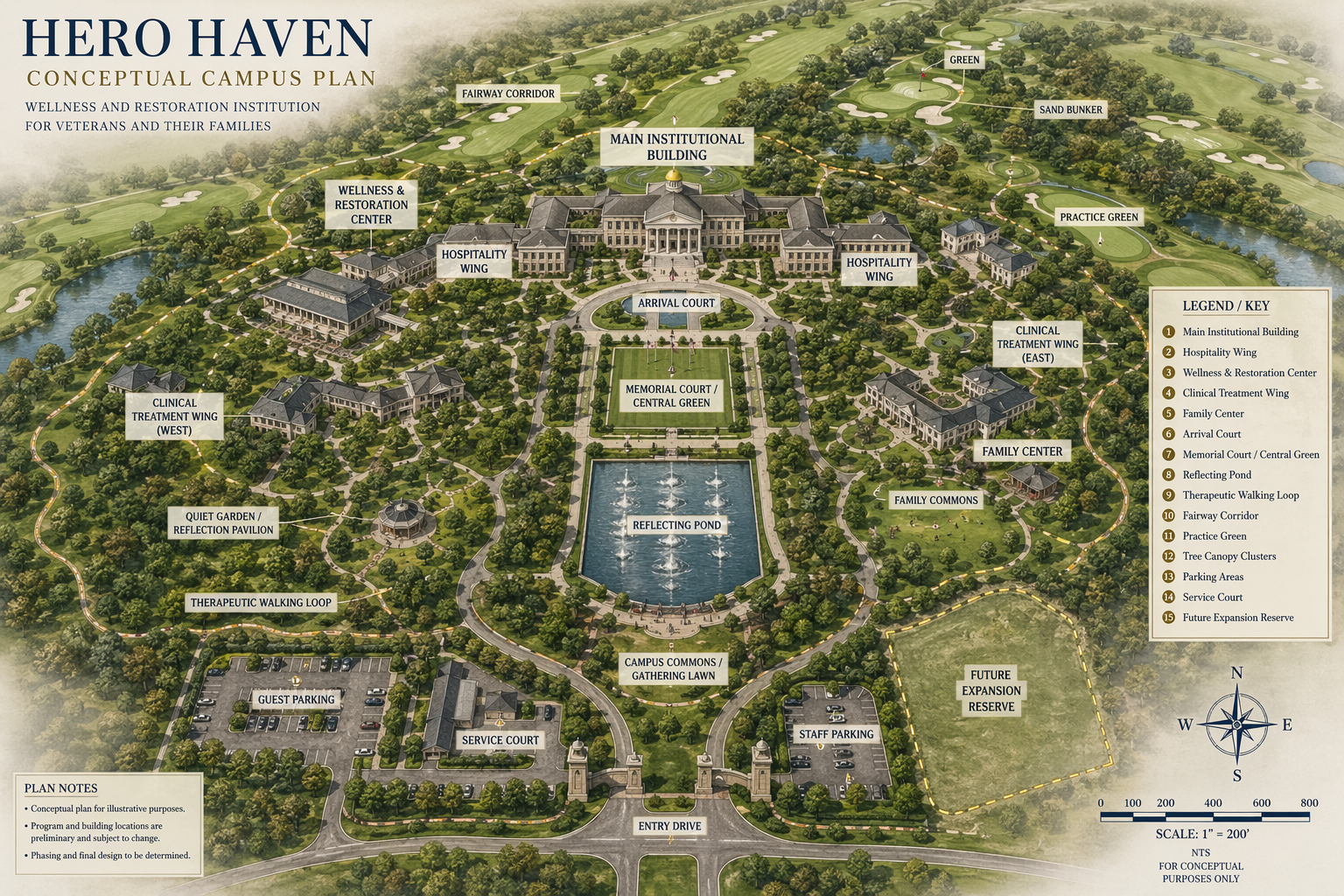
Hero Haven is not a response to a funding opportunity. It is a response to a structural gap that has existed too long — the absence of a permanent, nationally scaled wellness and restoration institution designed exclusively for veterans and their families.
The United States has invested substantially in acute veteran care and short-term reintegration programs. That investment reflects genuine commitment. And it has not been enough.
What exists instead is a fragmented landscape — and that fragmentation carries a cost that is borne, quietly and continuously, by veterans and families who deserved more. Programs end. Funding cycles. Staff turn over. The veteran moves on, carrying what wasn't resolved.
Hero Haven is intended to answer that gap — not with a program, but with a place. Not with a grant cycle, but with a governed institution. Not with good intentions, but with the infrastructure of permanence.
Family restoration is a program pillar — not an add-on. Service to the veteran and service to the family belong inside the same model.
The campus experience, programming, and hospitality are designed for veterans and their families together — not in parallel tracks that never fully meet.
Recovery is not an event. Hero Haven is designed to support the long arc of restoration — for the veteran and the family system they return to.
The institution's regard for veterans and families is communicated not through ceremony, but through the quality and permanence of what is built for them.
Hero Haven is built on a straightforward conviction: long-term veteran restoration cannot be meaningfully separated from the family system. The families of those who serve carry the weight of service alongside the veteran — and their restoration belongs inside the same institution.
Most veteran-serving programs treat the family as a peripheral consideration. Spouse programming runs in parallel. Children are accommodated, not included. The family waits while the veteran is served.
Hero Haven is being designed differently. Family restoration is a program pillar, not an add-on. Service to the veteran and service to the family belong inside the same model, the same campus experience, and the same institutional commitment.
"Hero Haven recognizes the family as part of the restoration equation — not a support group on the periphery, but an integral element of the institution's mission."
Hero Haven Language Identity · Family Standard
At Hero Haven, golf is not incidental, ornamental, or merely a prestige feature. It is an anchor feature of the institution's programming — a therapeutic modality integrated into the full restoration model. Golf provides rhythm, relationship, outdoor presence, and a pathway of participation that can be repeated, revisited, and built on over time.
Hero Haven's wellness programming is designed to support the whole veteran and family system — not a single dimension of recovery. Evidence-informed programming, clinical partnership, and long-arc restoration planning are integrated into a model that treats wellness as an ongoing discipline, not an episodic event.
Hospitality at Hero Haven is not the institution's primary identity. It is the infrastructure of dignity that makes the mission possible. Destination-quality lodging, dining, and guest experience are in service of restoration — communicating from the moment of arrival that this place was built for the people it serves.
Texas is not a coincidental location for Hero Haven. It is the strategically correct one. Its military heritage, land scale, philanthropic capacity, and cultural alignment with service give it the credibility and infrastructure to host a project of national consequence.
Hero Haven is intended to be Texas-based, but not Texas-limited. The aim is to establish an institution in Texas that carries national significance — drawing donors, partners, and veterans from across the country and setting a standard that other institutions can study and aspire to.
Texas is home to more active-duty military and veteran residents than nearly any other state in the nation. The institution's home state is its clearest expression of mission alignment.
The 300–500 acre campus vision requires land at a scale that Texas can accommodate — at a price that makes the capital structure viable without compromising the institutional vision.
Texas has produced a generation of philanthropic capital aligned with legacy institutions, service missions, and landmark civic projects. Hero Haven belongs in that tradition.
The Texas ethos of service, independence, and enduring commitment aligns with the institutional character Hero Haven is being built to embody. This is not coincidental — it is foundational.
Hero Haven is not best understood as a resort that serves veterans. It is a wellness and restoration institution for veterans and their families that is built at a destination quality because the mission demands it and the population it serves has earned it.
Its significance lies in what it seeks to become: not merely a property, but a place of consequence. Not merely a venue, but an institution that changes the standard of what is possible for those who served.
"By combining destination-quality design, golf as a therapeutic and relational pillar, integrated wellness and hospitality, and family-centered programming inside a governed, permanently endowed institution, Hero Haven seeks to establish a new category of service for those who served."
Hero Haven is in formation. Whether as a donor, a partner, a veteran, or someone who simply believes this institution should exist — the path forward begins with a conversation.